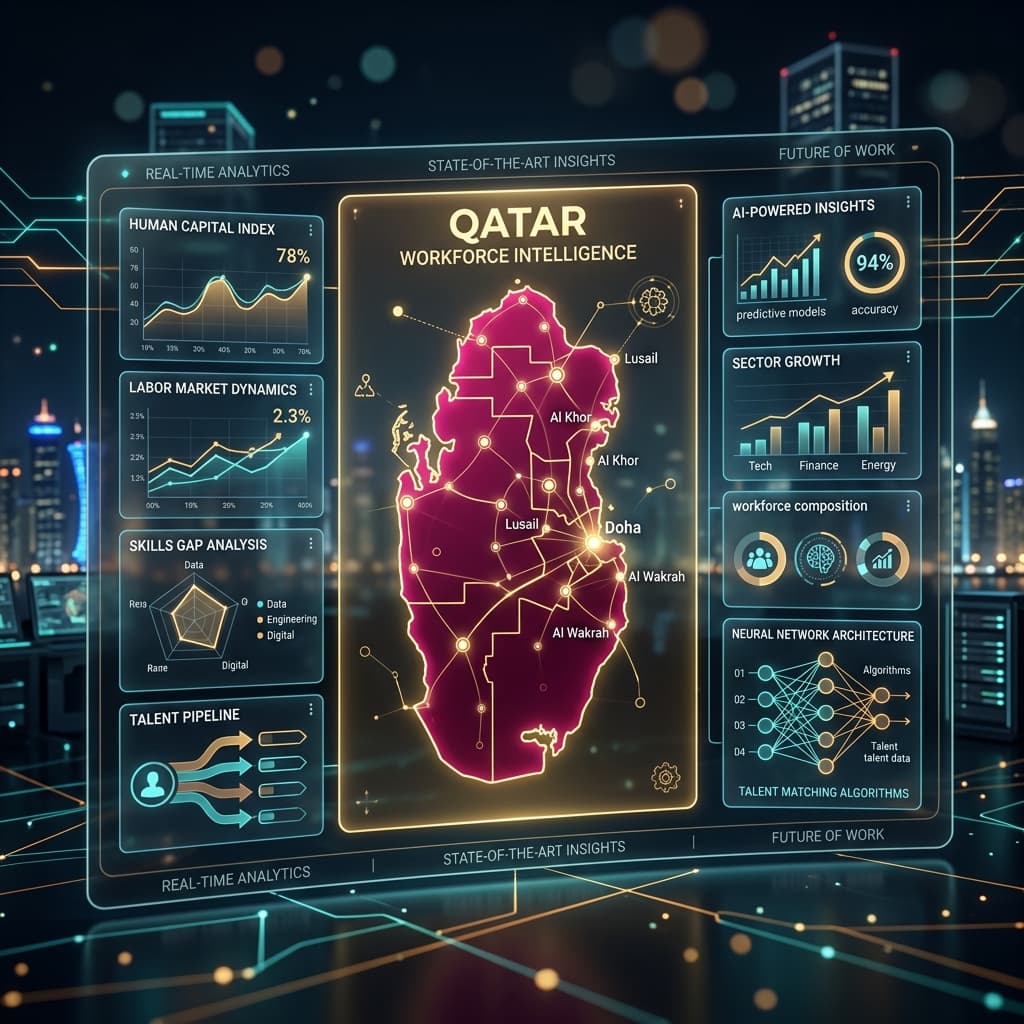
Qatar is moving fast. The economy is diversifying. New industries are growing. And the government has set clear targets for how many Qatari nationals should be working in the private sector by 2030. The policies are in place. The laws are active. But there is one thing standing between a good plan and real results the quality of the information behind every workforce decision.
Right now, many of those decisions are being made on data that is months old. Employers are hiring without full visibility of the talent available.Many traditional workforce systems face challenges keeping pace with rapidly changing labour market needs . And skilled Qatari nationals are sometimes missed simply because no live, connected system exists to match them to the right opportunities.
This is the core challenge for Qatar workforce strategy in 2026. It is not a problem of ambition. Qatar has plenty of that. : It is a problem of intelligence: real-time, verified, AI-powered intelligence that turns a national workforce plan into daily action. This blog looks at why that intelligence is now essential, and what it looks like when it works.
What Is a Workforce Strategy and Why Qatar Needs One
A Qatar workforce strategy is not just a hiring plan. It is the system a government uses to understand its people who is working, what skills they have, where the gaps are, and how to move the right talent into the right roles at the right time. Without this, every workforce decision becomes a guess. And in a country with targets as serious as Qatar's, guessing is not good enough.
The challenge is that most workforce strategies today are built on slow information. Governments collect data through annual surveys and reports that take months to produce. By the time that data reaches a policy maker, the labour market has already shifted. New roles have opened. Old skills are now less relevant. The picture being used to plan is already out of date.
Qatar workforce development depends on changing this. Not just collecting more data, but collecting the right data live, verified, and connected across all the systems that matter. That is the foundation of a workforce strategy that can actually deliver results.
Qatar's Workforce Development Plan for 2026
Qatar is currently in Phase Two of its National Strategy for an Effective and Highly Productive Workforce 2024–2030. This phase, running through 2026 and 2027, is specifically focused on reviewing government employment policies and growing the number of Qatari nationals in private sector jobs. It is the most active and demanding phase of the entire strategy.
The Qatarisation Law No. 12 of 2024, which came into full effect in April 2025, now legally requires private businesses to prioritise Qatari nationals in hiring.Non-compliance may lead to regulatory penalties under Qatarisation policies. This is not a guideline anymore. It is a binding legal obligation that every private sector employer in Qatar must follow.
According to Qatar's Third National Development Strategy 2024–2030, the government targets raising skilled workers to 46% of the total workforce by 2030.
Source: Third National Development Strategy 2024–2030, General Secretariat of the Council of Ministers, State of Qatar
Qatar workforce development goals are clear and measurable. The question is not what needs to be done. The question is whether the systems in place can support delivery at the speed and scale the strategy demands.
Why the Old Way of Workforce Planning No Longer Works
Traditional workforce planning methods can face limitations in fast-changing labour markets, it runs on old information. Government HR systems collect data through manual forms, reports, and periodic audits. By the time anyone analyses it, the labour market has already moved on.
Three points is where traditional planning consistently fails. First, data sits in silos ministries, employers, and authorities each hold separate pieces with no connected view. Second, credentials go unchecked false or inflated qualifications enter hiring pipelines undetected. Third, compliance is always reactive problems are spotted only after months of non-compliance have passed.
In Qatar's job market in 2026, these failures cost more than before. Qatarisation is now a legal requirement. Governments need systems that show what is happening now, not last quarter.
Why Qatar Needs Real-Time Talent Intelligence Now
Workforce intelligence Qatar needs is not simply more data points on a spreadsheet. It is live, verified, connected information that decision-makers can act on immediately. Real-time talent intelligence means knowing at this moment how many verified Qatari professionals are available in a given sector, which skills are undersupplied, and whether employers across the country are meeting their Qatarisation obligations.
According to the Qatar Ministry of Labour's National Workforce Strategy 2024–2030, Qatar aims to increase Qatari nationals working in the private sector from 17% to over 20% by 2030.
Moving from 17 percent to 20 percent sounds like a small shift. But achieving it across a workforce where foreign nationals make up the vast majority of private sector employees requires precise, real-time information about exactly where Qatari talent exists, what roles are open, and whether placements are happening at the right pace. Without live intelligence, this target becomes very difficult to track ,let alone achieve.
Real-time talent intelligence also protects Qatar's job market in 2026 from a common and costly problem: skills mismatch. When governments can see in real time which skills are in demand and which are already oversupplied, training investment goes to the right places. Money is not wasted building a pipeline of talent that the market does not need.
How AI Turns Workforce Data Into Smart Decisions
Artificial intelligence makes real-time workforce intelligence possible at a national scale. Instead of waiting for periodic reports, an AI-powered platform processes live data continuously matching candidates to roles and flagging credential problems before they enter the hiring pipeline.
Here is what AI can do that traditional planning cannot:
- Verify credentials instantly against national ID and civil records
- Match verified Qatari nationals to open private sector roles
- Track Qatarisation compliance in real time across all employers
- Identify skills gaps by sector before they become critical
These capabilities exist today. The only question is whether the right platform is in place to drive Qatar workforce development forward.
How KAFA’A Brings Workforce Intelligence to Qatar
KAFA’A is an AI-powered workforce platform built for GCC governments. It solves the exact problems Qatar's workforce strategy faces today slow verification, disconnected data, and compliance systems that fall behind.
The platform is designed to support secure candidate verification workflows and workforce intelligence for GCC governments . No manual checking. No fraudulent credentials. The AI of kafa’a then matches verified Qatari nationals to private sector roles based on actual skills and live market demand.
Government authorities get live, auditable compliance reporting at all times. Every placement is recorded.The platform is designed with enterprise-grade data security and compliance considerations for GCC organizations . This is the workforce intelligence Qatar needs powering real Qatar workforce development, every single day in 2026.
Conclusion
Qatar's laws are written. The targets are set. The Qatar workforce strategy is already in motion. What determines success now is the intelligence behind every decision which roles to fill, which skills to fund, and whether compliance is being tracked in real time.
Governments that act now will place Qatari nationals faster, close skills gaps earlier, and prove progress with verified data. Qatar workforce development cannot wait for slower systems to catch up. The 2030 goals are close. The window to build the right infrastructure is narrowing. KAFA’A is ready. The decision is yours.